
Our versatile cementless acetabular cup system
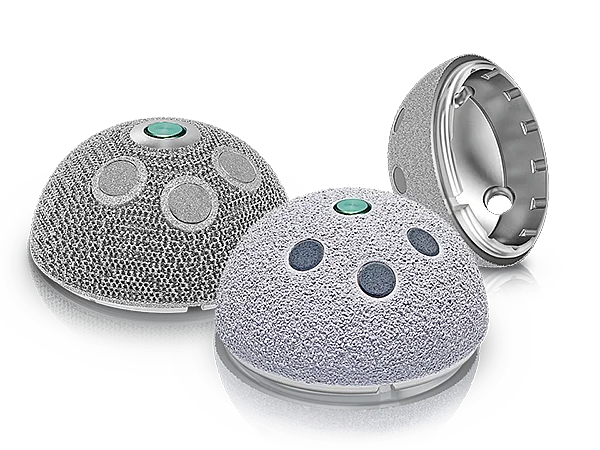
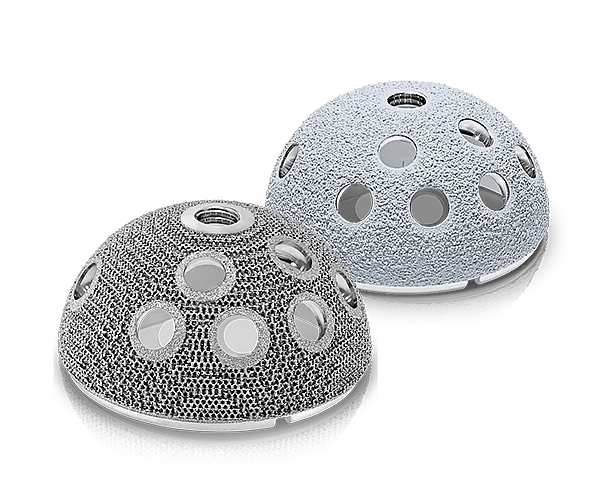
Many years of experience with successful implant systems and a range of fixation concepts, together with state-of-the-art material and coating technologies, have gone into the development of this new acetabular cup system. The result is the versatile cementless MobileLink Acetabular Cup System, which includes three different press-fit cups: a cluster-hole cup, a multi-hole cup, and a tri-flanged multi-hole cup (Partial Pelvis Replacement).
Surface options include the PlasmaLink coating, the TiCaP double coating, and the TrabecuLink surface structure.
The MobileLink Partial Pelvis Replacement - Where adaptability becomes standard
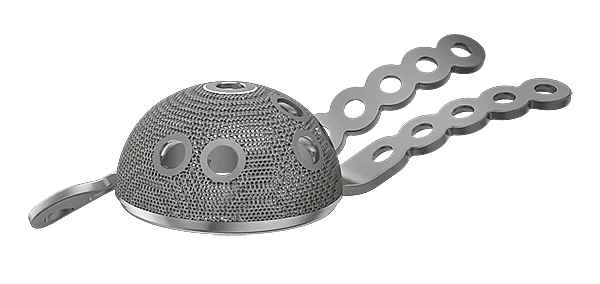
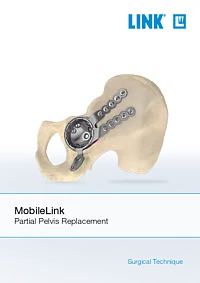
The MobileLink Partial Pelvis Replacement combines custom-like adaptability with off-the-shelf availability for the treatment of large acetabular defects.
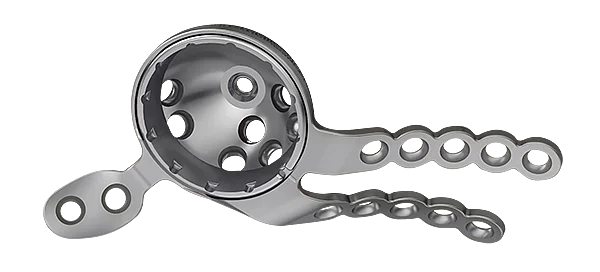
The acetabular component incorporates the proven TrabecuLink surface structure and offers multiple screw fixation options to support secure implant fixation. Three titanium fixation flanges (two 5-hole cranial flanges and one 2-hole caudal flange) can be adjusted intraoperatively in length and shape, helping surgeons address individual pelvic anatomies and defect scenarios.
As an extension of the MobileLink Acetabular Cup System, it allows the use of established MobileLink inserts and provides a versatile platform for complex primary, revision, and oncological cases.

The MobileLink Acetabular Cup System can be used with different insert options
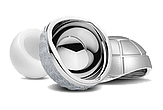
The MobileLink cups are compatible with ceramic and poly inserts*, which are available in standard and anti-luxation designs. Both poly insert designs are offered in X-LINKed and E-DUR (Vit.-E) material options.
For advanced reconstruction needs, MobileLink Face Changers provide additional modularity through offset and inclination correction. This enables more anatomical restoration and greater intraoperative flexibility in revision surgery. In addition, the adapters allow the use of ceramic inserts in revision arthroplasties.
The MobileLink Acetabular Cup System can be transformed into a modular dual mobility system, using Dual Mobility Inserts made from EndoDur. The DM insert is designed to accommodate poly DM liners from the BiMobile Dual Mobility System and can optionally be combined with Face Changers.
*The MobileLink PPR is exclusively compatible with poly inserts.
Benefits of Dual Mobility
Originally developed by Prof. Gilles Bousquet in the 1970s to help prevent recurrent hip dislocations, the Dual Mobility concept combines a highly polished Dual Mobility Insert with a mobile polyethylene liner that captures the prosthetic head. Together, these components create a modular system designed to enhance stability while maintaining mobility.
- Dual mobility reduces risk of dislocation and increases range of motion (RoM) 5
- Polished inner surface for minimized wear and a prolonged implant life 6,7
- Self-centering Liner promotes even wear patterns and enhances dislocation resistance 8

Features and Advantages

Wide range of sizes
- 42 - 72 mm
- 74 - 80 mm, on request

Triple locked inserts
Secure fixation of polyethylene insert to shell by a “snap-lock mechanism”, conical coupling and antirotation tabs

Intraoperative flexibility
One instrument platform for primary
and revision surgery

Latest material selection
- E-DUR polyethylene
- X-LINKed polyethylene
Ceramic

3 dimensional TrabecuLink structure
The pore size, porosity and type of structure ensure an excellent cell fill3,4,9

Dual Mobility Insert
Dual mobility leads to reduced risk
of dislocation and increased range
of motion (RoM)6

Streamlined surgical experience
through simple, ergonomic instruments
and color coding

50/36 – Outside small, inside big
36 mm prosthesis heads starting from
50 mm shell size for polyethylene inserts

Face Changer
Shell/Insert Adapter (Face Changer) to
adjust inclination or/and offset

Rough Titanium-Plasma +
HX Coating TiCaP
Double layer coating promotes
bony ongrowth1,2

Color coding
for streamlined workflow

Variable bone screw options
- Cluster Hole Shell screw holes are
pre-closed with removable caps - +/-15° screw angulation possible

TiCaP double coating
The TiCaP double coating combines a porous surface for primary fixation with our osteoconductive2 HX calcium phosphate coating. It is applied by first vacuum plasma spraying a highly dense adhesive layer of titanium, approximately 450 µm thick, onto the surface of the implant. On top of this roughened surface, an approx. 15 µm thick HX layer of mechanically stable, but quickly soluble, calcium phosphate is deposited in an electro chemical process. This combination is designed to give optimal primary stability and osseointegration.
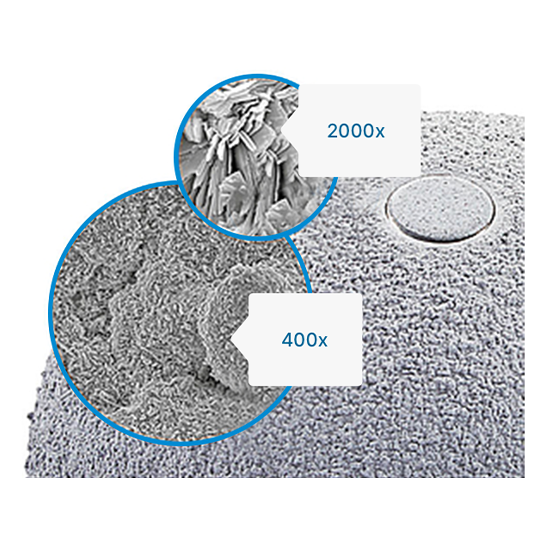
The 3-dimensional TrabecuLink structure
The 3-dimensional TrabecuLink structure, with its pore geometry (porosity: 70%, pore size: 610-820 μm, structure depth: up to 1 mm) ensures excellent cell ongrowth. 3,4,9
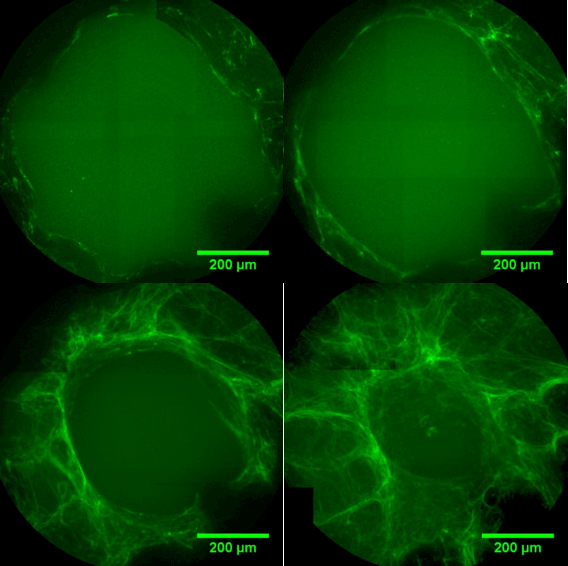
Pore filling
The sequence of images shows a pore of the TrabecuLink structure being filled with tissue under in-vitro cell culture conditions. The fibronectin laid down by human fibroblasts and continually reorganized over a period of eight days is visible as green fibers. Fibronectin is a component of the extracellular matrix that is formed at an early stage of the healing process. It forms a basis for the embedding of collagen, which is essential for mineralization of the tissue and ingrowth of bone into the structure. Apart from the accumulation of fibronectin, which increases over time, a clear contraction of the matrix towards the center of the pore can be observed. This contraction mechanism, which is attributable to the cellular forces acting in the tissue, accelerates the rate at which the pore is filled with tissue, compared to a layer-by-layer tissue growth (Reference: Joly P et al., PLOS One 2013;
https://journals.plos.org/plosone/article?id=10.1371/journal.pone.0073545). Julius Wolff Institute, Charité - Universitätsmedizin Berlin

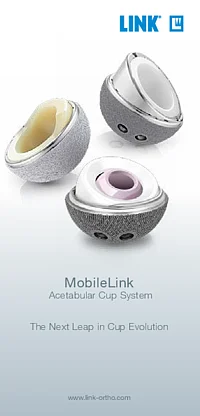
MobileLink Trailer
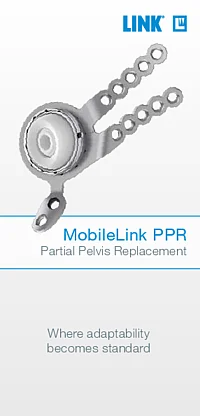
MobileLink PPR



Sources
- Ullmark G, Sorensen J, Nilsson O. Analysis of bone formation on porous and calcium phosphate-coated acetabular cups: a randomised clinical [18F]fluoride PET study. Hip international: the journal of clinical and experimental research on hip pathology and therapy. 2012;22(2):172-8.
- PCT-Patent Application WO 2017/140497 A1
- Cecile M. Bidan, Krishna P. Kommareddy, Monika Rumpler, Philip Kollmannsberger, Yves J.M. Brechet, Peter Fratzl, John W.C. Dunlop. et al.; How Linear Tension Converts to Curvature: Geometric Control of Bone Tissue Growth; PLoS ONE 7(5): e36336. doi.org/10.1371/journal.pone.0036336 (2012)
- Pascal Joly, Georg N. Duda, Martin Schöne, Petra B. Welzel, Uwe Freudenberg, Carsten Werner, Ansgar Petersen, et al.; Geometry-Driven Cell Organization Determines Tissue Growth in Scaffold Pores: Consequences for Fibronectin Organization; PLoS ONE 8(9): e73545. doi.org/10.1371/journal.pone.0073545 (2013)
- Stroh, D. Alex, et al. "Dual-mobility bearings: a review of the literature." Expert review of medical devices 9.1 (2012): 23-31.
- Long, M., & Rack, H. (1998). Titanium alloys in total joint replacement—a materials science perspective. Biomaterials, 19(18), 1621-1639
- Loving L, Herrera L, Banerjee S, Heffernan C, Nevelos J, Markel DC, Mont MA. 2015. Dual mobility beari ngs withstand loading from steeper cup-inclinations without substantial wear. J Orthop Res. 33(3):398-404.
- Fabry C, Kaehler M, Hermann S, Woernle C, Bader R. 2014. Dynamic behavior of tripolar hip endoprostheses under physiological conditions and their effect on stability. Medical Engineering & Physics 36:65– 71.
- Steinemann SG; Compatibility of Titanium in Soft and Hard Tissue – The Ultimate is Osseointegration; Materials for Medical Engineering, WILEY-VCH, Volume 2, Page 199-203